
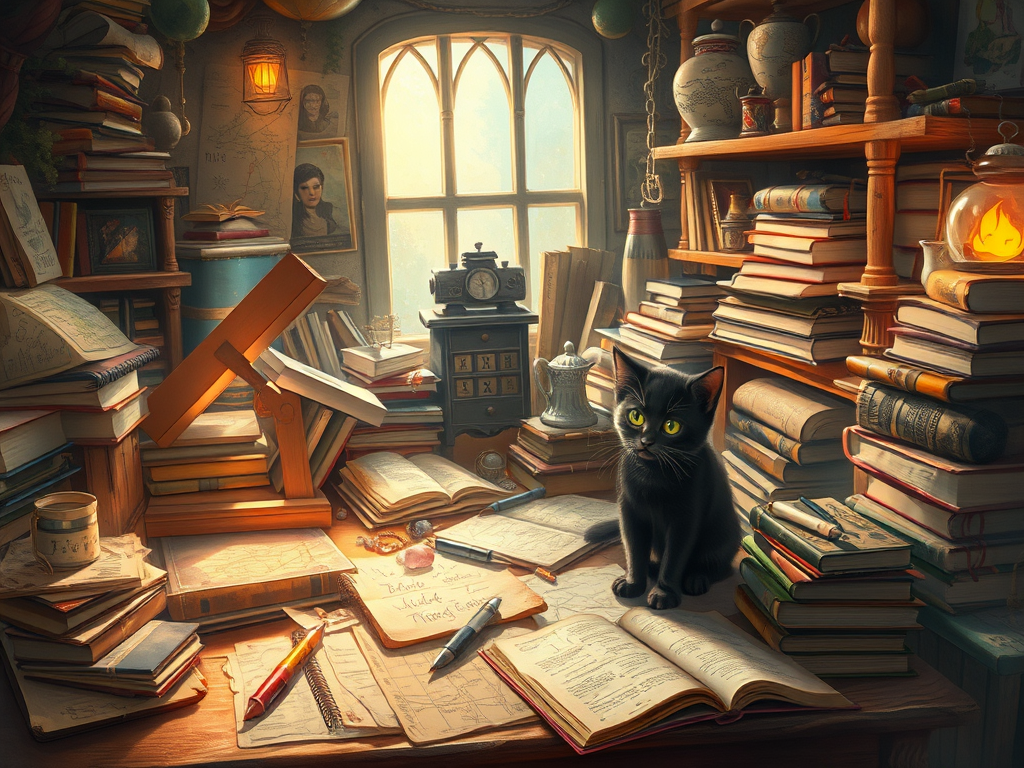
Writers are often asked, “Do you outline first, or just dive in?” My answer lately has been, “Both. And I also talk to a pocket scribe named ChatGPT.”
Since starting Embermarked, the first book in the Dawnreach trilogy, I’ve been building a world full of tangled history, hidden magic, and three very different heroines. It’s big. Like…continent-level big. And managing the threads, character arcs, magical systems, timelines, flora, fauna, politics, moon names, ceremonial knives (yes, really) feels a bit like trying to bake three different batches of cupcakes (all different flavors) at once while Pippa, my curious kitten, insists on rearranging the measuring cups and making off with the cinnamon. Somehow it still turns out, but there’s flour in my hair and paw prints on the counter.
Enter ChatGPT. Not as a writer, but as a collaborative tool. Think: queryable world-building assistant, fast-researcher, and lore librarian who never sleeps.
Here are a few ways I’ve used it:
Organizing a Living World
Dawnreach isn’t just a map. It’s three distinct nations with their own cultures, rulers, and versions of magic. To keep it all straight, I use ChatGPT like a running wiki. It remembers the names of Anna’s sisters, the political tensions between Aurivale and Sablemere, and which of my fictional moons rises at the Embermoon festival. I can ask things like “What’s Anna’s second magical specialty again?” or “Remind me what happens during the Kindlemark ritual,” and get instant clarity. It’s helped me stay immersed without constantly flipping through scattered notes or losing momentum.
Creating Searchable Personas
Because each character has their own way of being in the world, with different motivations and personalities, I’ve used ChatGPT to refine them like living personas. I’ve built in traits, tensions, and arcs over time, asking questions like “What would Mora do if she were called out for being really good at something?” or “How would Anna handle betrayal from someone she loves?” These aren’t static character sheets. They evolve as the story does. And because the AI can “remember” past development, I can build richer, more nuanced personalities without constantly retracing steps.
Researching the Real to Ground the Imagined
While Dawnreach is a fantasy realm, I want the details to feel real. So I’ve pulled ChatGPT in for quick, immersive research:
• What are the parts of a knife called?
• What did rangers in medieval climates wear during training?
• How do you dye wool with natural materials?
• What’s the sound of a golden wren?
Having a fast research assistant on call means I can keep the writing flow going, rather than falling into a Google rabbit hole about leather embossing techniques. (Not that that’s ever happened. Ahem.)
Collaborating Without Losing Voice
Let’s be clear—ChatGPT doesn’t write for me. Every word in Embermarked comes from my hands. But it helps me think, brainstorm, and stay in rhythm. It asks good questions back. It offers variations when I need five ways to describe moonlight. And it keeps my brain from stalling when I’m juggling twenty threads and still trying to remember what color Mora’s sash was.
Honestly, it feels like having a writing room with a research assistant, a continuity editor, and a character therapist all rolled into one.
If you’re curious about how to use tools like this in your own writing process, or just want to peek behind the scenes of Dawnreach, drop me a note. And if you’re the kind of reader who loves stories about girls who wield kindness and knives, stay tuned. There’s more magic coming!